Unearthed Treasures – episode #8 : Kaiserin Elisabeth von Osterreich
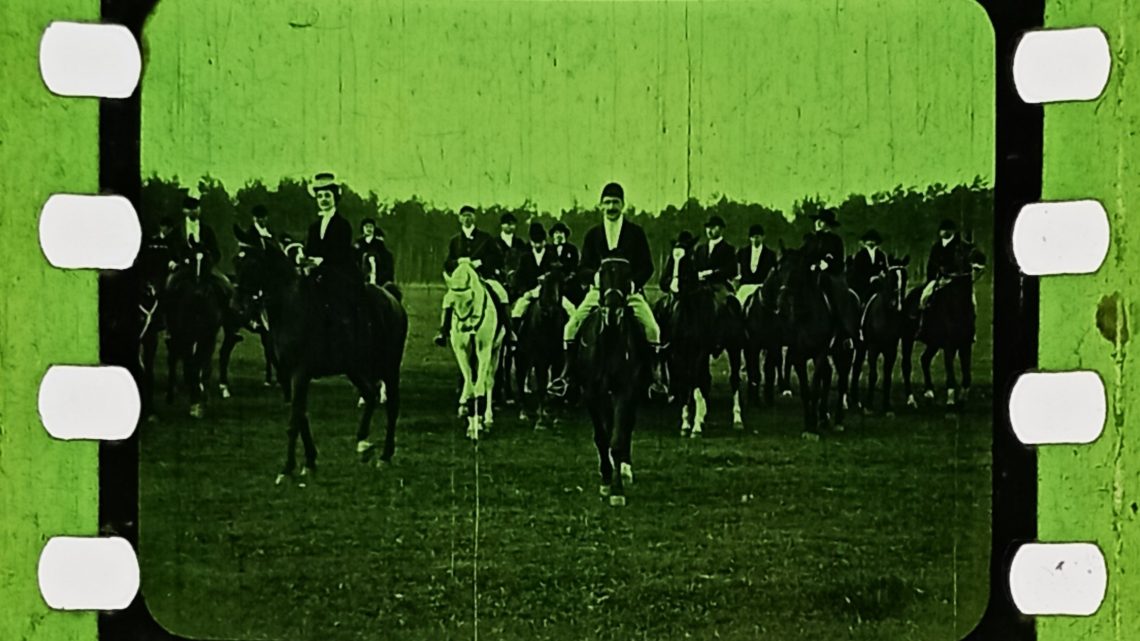
After France and the United States, let’s now turn to Germany for this new episode of Unearthed Treasures and take a closer look at Kaiserin Elisabeth von Österreich, directed by Rolf Raffé in 1921, an excerpt of which was found in the “Calais batch” in April 2025.
1 – Sissi and the Family
Empress Elisabeth of Austria, born Elisabeth of Wittelsbach—better known as “Sissi”—has always fascinated filmmakers, and her figure runs through film history from the silent era to the present day. Married at just sixteen to Emperor Franz Joseph, this tragic female figure has been portrayed by many actresses, the most famous being Romy Schneider, and her turbulent life has been brought to the screen by renowned directors such as William Dieterle, Joseph von Sternberg, Anatole Litvak, as well as Jean Delannoy and Luchino Visconti.
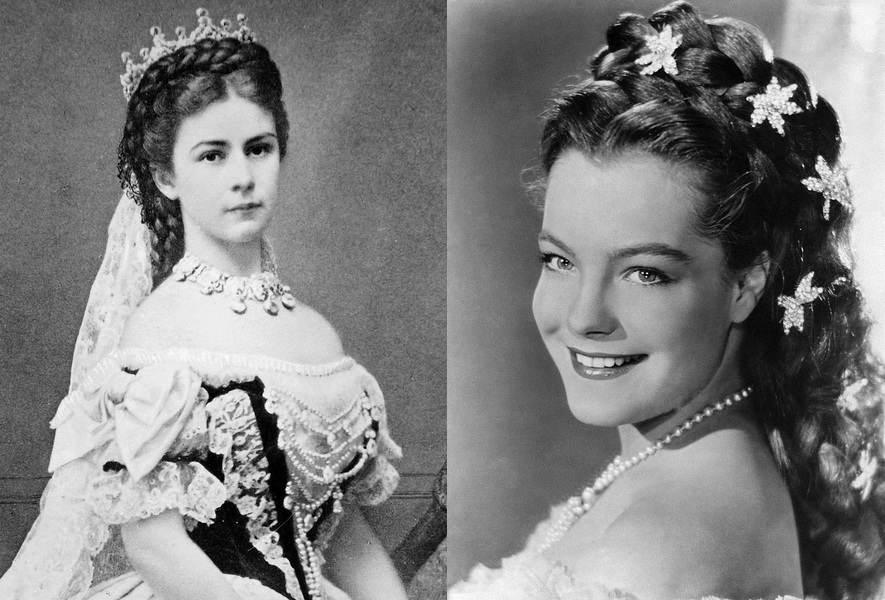
On the left, the real Sissi; on the right, her portrayal on screen by Romy Schneider
It is often difficult—if not outright impossible—to determine the very first appearance of a given historical figure in cinema. One can, however, state with some confidence that one of the earliest films to portray the Empress of Austria is Das Schweigen am Starnberger See, directed by Rolf Raffé in 1920 for the company Indra-Film, which he had just founded in Munich in 1919.
The director seems, in fact, to have developed a particular interest in the Habsburgs: after Kaiserin Elisabeth von Österreich in 1921, Rolf Raffé went on to direct Das Schicksal derer von Habsburg in 1928—making a total of three films devoted to this illustrious dynasty within the span of eight years.
The rest of the career of the man born Anton Gustav Steichele remains relatively little known today. Still, it is worth mentioning Rex Mundi (1924), Sklaven des Geldes (1926), and Die Bettlerin von Paris, his first sound film, whose production was halted due to lack of funding.
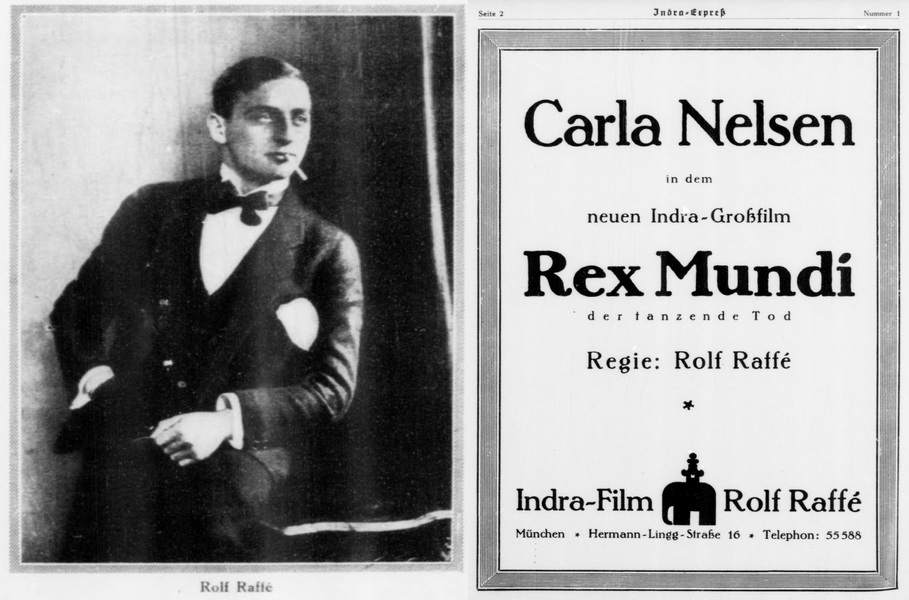
As can be seen on the poster above, Rolf Raffé’s muse was the actress Carla Nelsen, whom he married in 1919 and cast repeatedly in his films. She played the role of Empress Elisabeth twice, in Das Schweigen am Starnberger See and Kaiserin Elisabeth von Österreich, before being replaced by Erna Morena in 1928 in Das Schicksal derer von Habsburg.
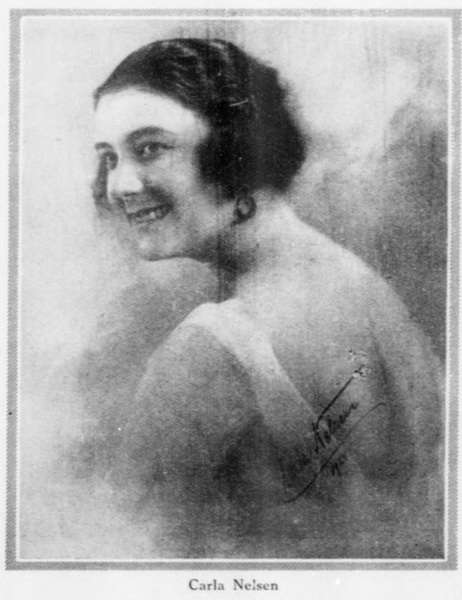
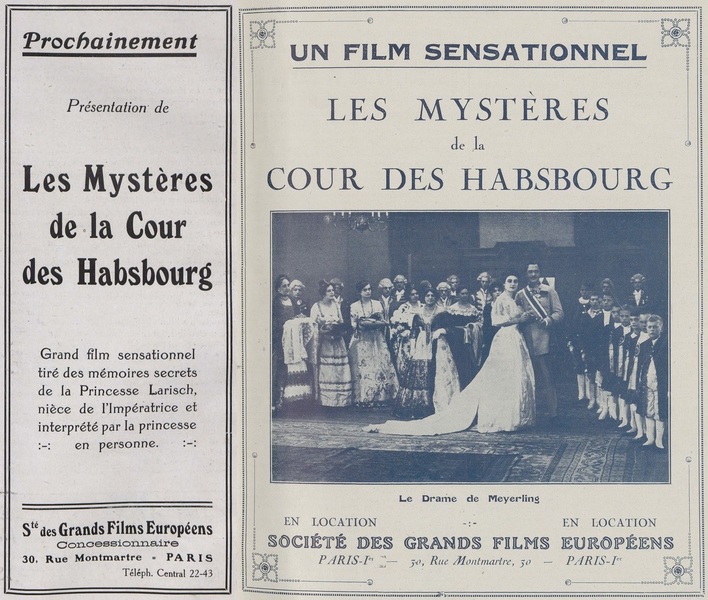
According to several press articles, Kaiserin Elisabeth von Österreich was reportedly written by Rolf Raffé based on the memoirs of the Empress’s own niece, Princess Larisch, who is even said to have played herself in the film. In any case, the project was ambitious in scope, aiming to depict “the reign of Francis Joseph, his marriage to Elisabeth, his intrigues with Princess Garzewska, the disappearance of John Orth, the death of Ludwig II of Bavaria, and the tragic end of the Archduke, heir to the throne.”i
Filming began in September 1920, with sequences shot in Geneva at the actual locations associated with Sissi’s stay (notably the site where she was assassinated by an anarchist on 10 September 1898), as well as at Schönbrunn Palace, where Francis Joseph I spent a large part of his life.
2 – A “Great European Film”
For its release in France, distribution was handled by the newly founded company Les Grands Films Européens. Based on rue Montmartre in Paris’s 9th arrondissement, the company aimed, as its name suggests, to acquire the distribution rights to prestigious foreign films and release them on the French market.
According to our research, however, these “European” films were in fact all German: Kaiserin Elisabeth von Österreich, of course, but also later The Man in the Iron Mask (Der Mann mit der eisernen Maske, 1923, Max Glass) and Nathan the Wise (Nathan der Weise, 1922, Manfred Noa). The trauma of the First World War was still fresh, and French audiences were likely reluctant to go to the cinema to watch “Boche” films. As a result, the label “Great European Films” proved more acceptable than “Great German Films,” allowing the distributor to obscure the true origin of the works it promoted.
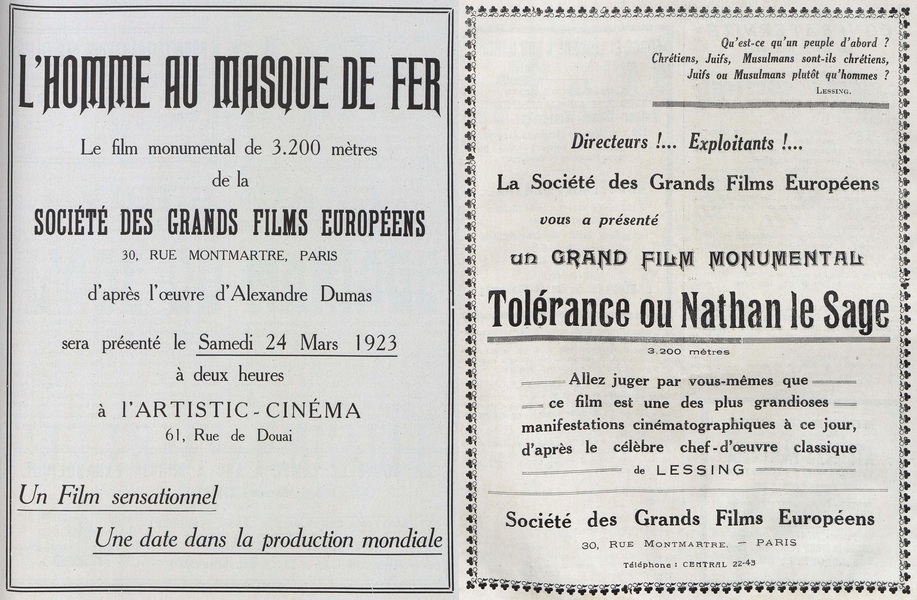
With its announced length of 8,500 metres, the release of Rolf Raffé’s epic was promoted with great fanfare under the more striking title Les Mystères de la Cour des Habsbourg (The Mysteries of the Habsburg Court). It was notably screened at the Max Linder cinema on 25 July 1922, and the press lavished it with superlative praise, describing the film as “sensational,” “admirable,” “moving,” and “unique.” While the reviews were generally positive—praising Rolf Raffé’s careful direction and the outstanding performances of the cast—the trade journal Hebdo-Film did not hesitate to point out certain shortcomings: “If the film seems long, if at times the interest is not sustained as it should be, this is because it has been edited in a rather rudimentary manner and with intertitles that will, for the most part, be changed.”ii
3 – On horseback !
With its French intertitles, the excerpt from Kaiserin Elisabeth von Österreich discovered in Calais in April 2025 therefore comes from a print distributed by Les Grands Films Européens in 1922, a fact confirmed by a credit that appears on one of the intertitles:
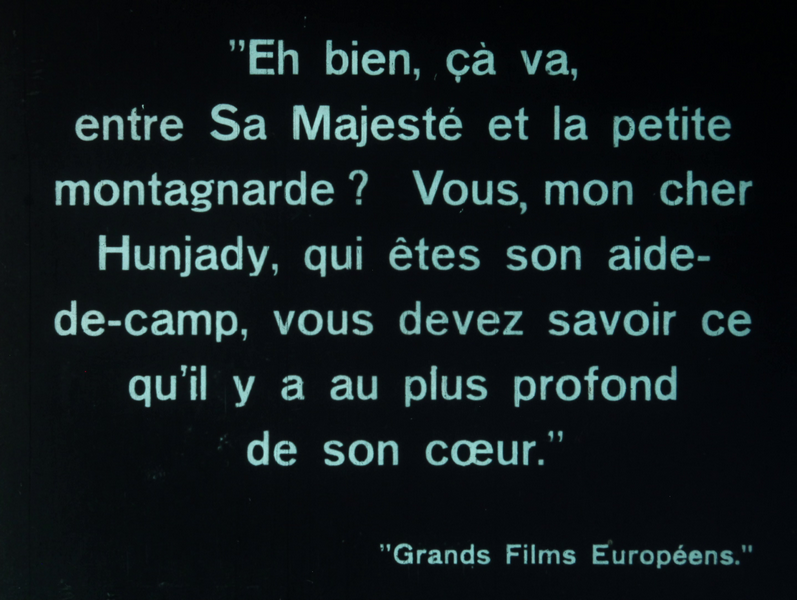
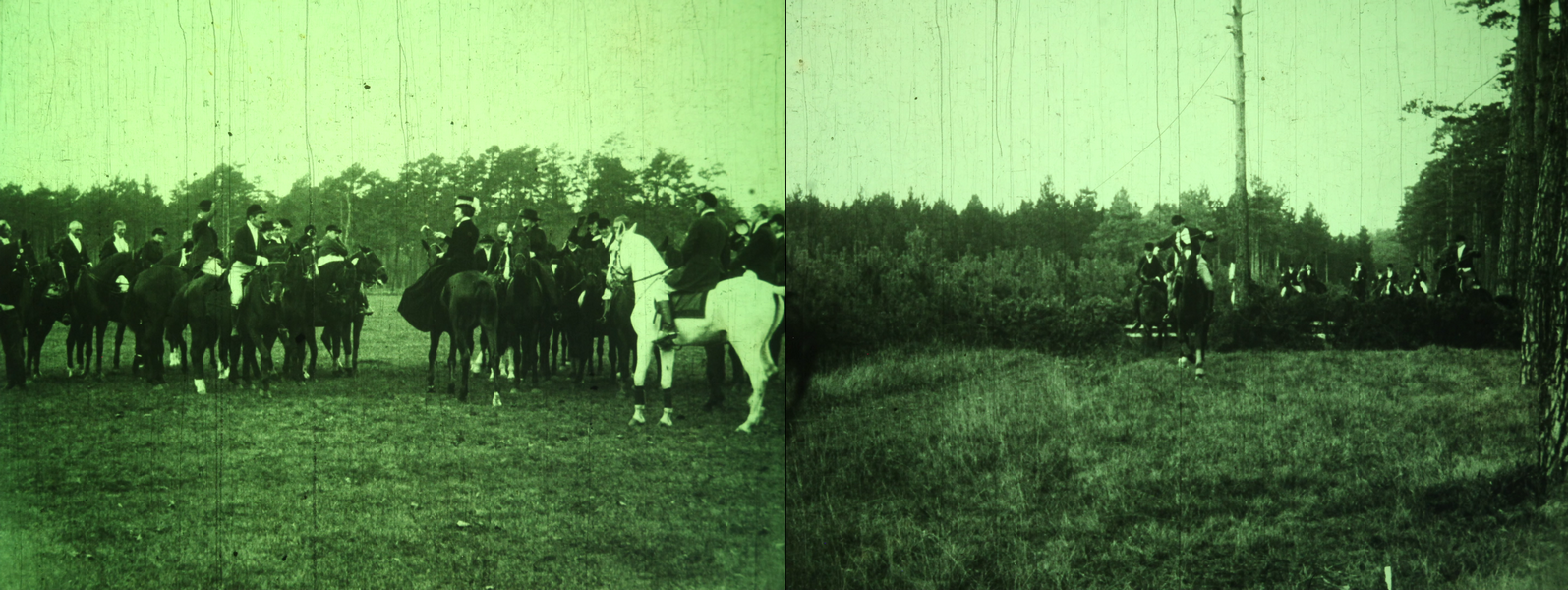
Although the film is not considered lost today (a print is held by the EYE Filmmuseum in Amsterdam), this excerpt from Les Mystères de la Cour des Habsbourg, measuring nearly 330 feet and entirely tinted (notably in a vivid green), constitutes a valuable testimony to the film’s distribution in France.
The journal Hebdo-Film published a detailed description of it in 1922, and it would seem that the excerpt in our possession comes from somewhere in the middle of the film, following sequences depicting the uprising in Hungary and the Empress’s visit to a hospital, where she meets a violinist named Féhèr: “Elisabeth seeks oblivion in sport; she rides, hunts, and trains horses.”iii
Check out my YouTube channel @ClassicinemaVault to rediscover this 5 minutes clip of Kaiserin Elisabeth von Osterreich, aka Les Mystères de la Cour Habsbourg.
iii – Hebdo-Film – 19 juillet 1922 – p.28